The World of Velur

Where Memory Whispers

A house of scent, memory, and art — born in the south of France, hidden for a lifetime, and revived all the way in the Emirates.

Where

Every space has its own feeling. We believe fragrance helps tell the story of a place — shaping how it is experienced and remembered by the people within it.

Memory

Scent has the power to preserve emotions, moments, and places beyond time. It creates a bridge between the past and the present, bringing memories back to life.

Whispers

The most lasting impressions are often the quietest. Like the memories that inspired Velur, our fragrances reveal themselves gently — a subtle yet enduring presence.

The Story of Velur

In a house that lived by tradition, one heart lived by feeling — and left behind a language written entirely in scent.

Chapter I — The House

A noble house in the south of France.

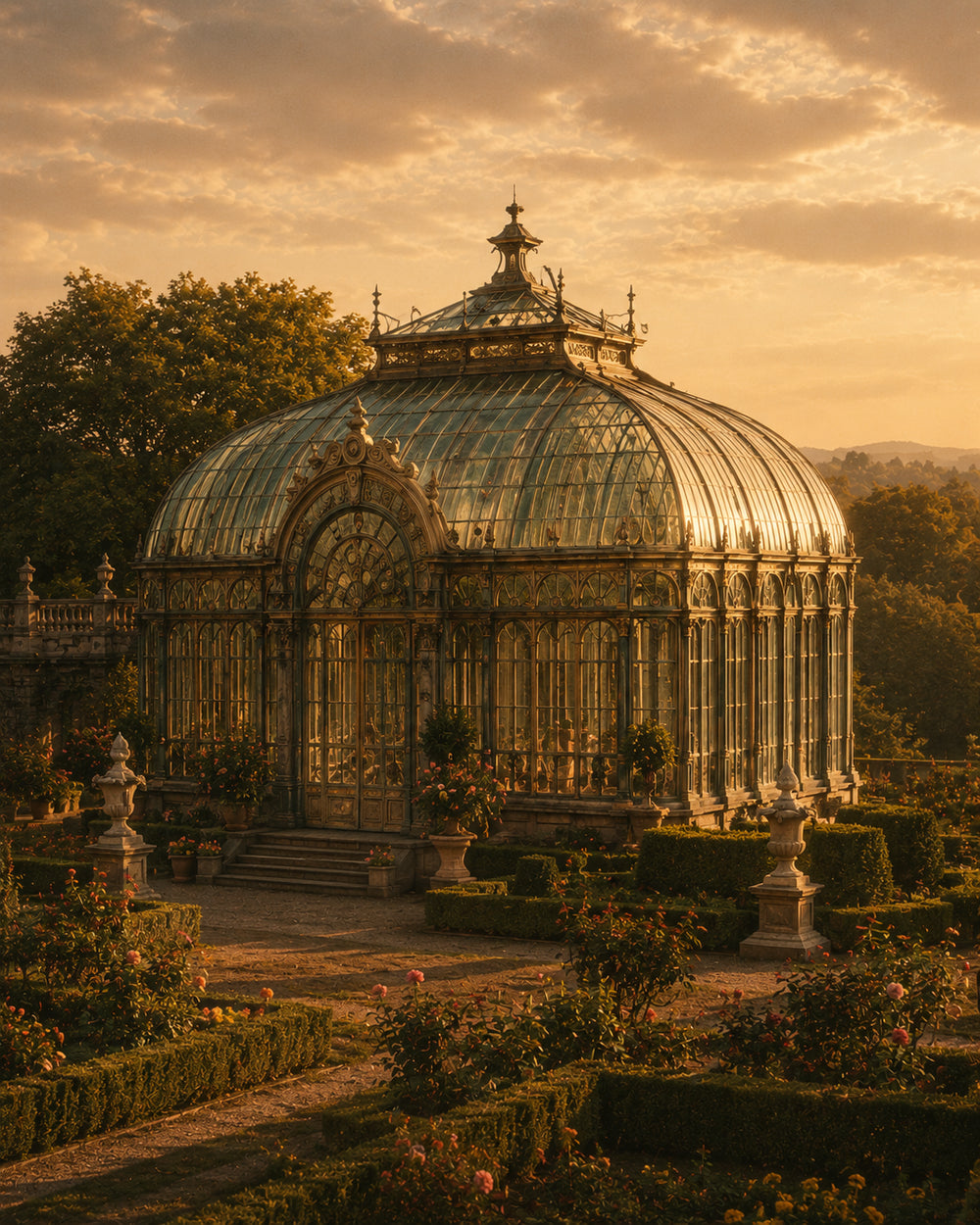
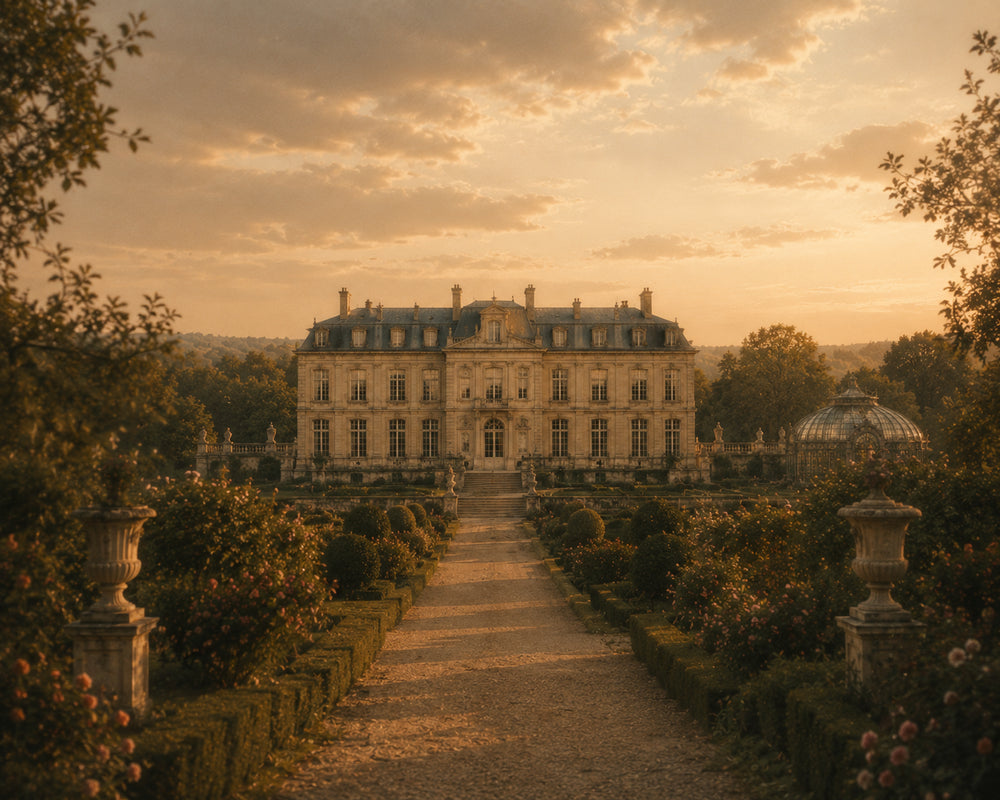
In the warm south of France, where the light falls slow and golden across the vineyards and the cicadas keep time through the long afternoons, there stood a noble house that carried its name like an heirloom. Its name was Velur.

For generations, the family lived by tradition, order, and inheritance. There were long dinners at a longer table, letters sealed in wax, portraits of ancestors watching from every wall, and a quiet, unspoken agreement that each life would follow the shape of the one before it.

And yet, in every ordered house, there is one heart that beats to a different rhythm. In this house, it was hers.

Chapter II — The Girl

The one who did not belong.

She was a daughter of the house — expected, like the others, to inherit its manners and its silences. But her heart was never drawn to the life around her. It was drawn to art, to nature, and to the small, secret emotions hidden inside ordinary moments: the hush before rain, the warmth of fruit left too long in the sun, the smell of her mother's shawl folded away in a drawer.

Where the family saw routine, she saw colour. Where they heard silence, she heard something waiting to be spoken. She was, to them, a little strange — a dreamer who wandered the gardens when she should have been at the table.

She did not argue with the house. She simply slipped away from it, whenever she could, toward the far end of the garden — where something warm and green was waiting for her.

Chapter III — The Glass House

A glass house, hidden among the trees.

Beyond the almond trees, past the edge of the formal garden, stood a small glass house — warmed by the sun, clouded with green, forgotten by everyone but her. She made it hers. It became her studio, her refuge, and the emotional origin of everything Velur would become.

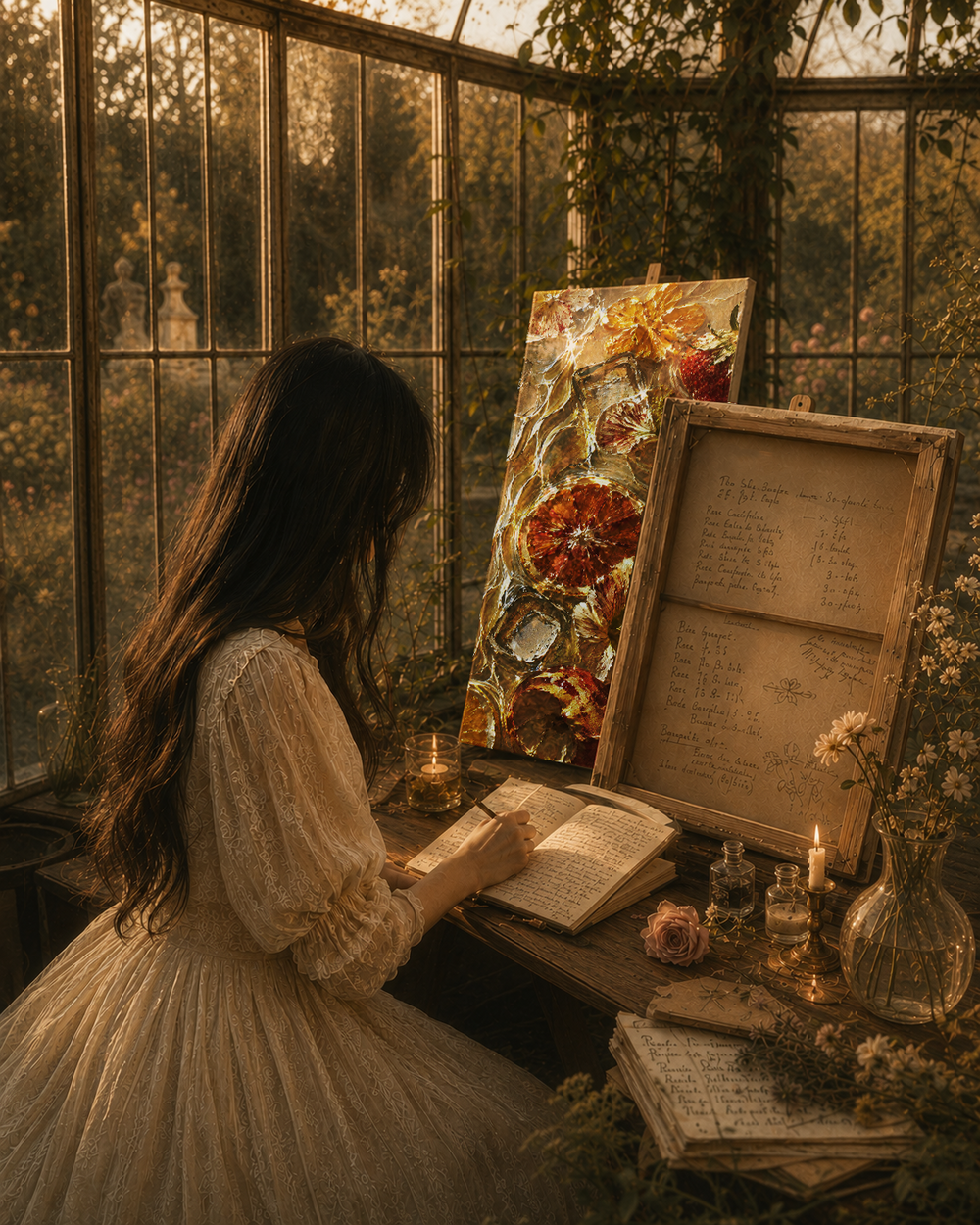
Inside, sheltered by warm panes, she gathered the world in pieces: flowers and fruits, herbs and resins, rain-soaked earth, bark, honey, smoke. She laid them out the way a painter lays out colour — not by rule, but by feeling. She crushed, she steeped, she waited, and slowly her experiments began to turn into recipes.

Each one held a single moment. A summer storm over the vineyard. An orchard at noon. The cold a winter visitor carried in on his coat. She was not making perfume. She was painting memories — in air.

For her, fragrance became more than scent. It became a language of memory — a way to hold on to emotions, places, and people long after time had tried to take them away.

Chapter IV — The Secret

Written in diaries, hidden behind paintings.

She wrote her formulas by hand, in a private script only she could read, filling the margins of her diaries with measures and notes and the little stories behind each scent. But some fragrances felt too precious, too personal, to leave on an open page.

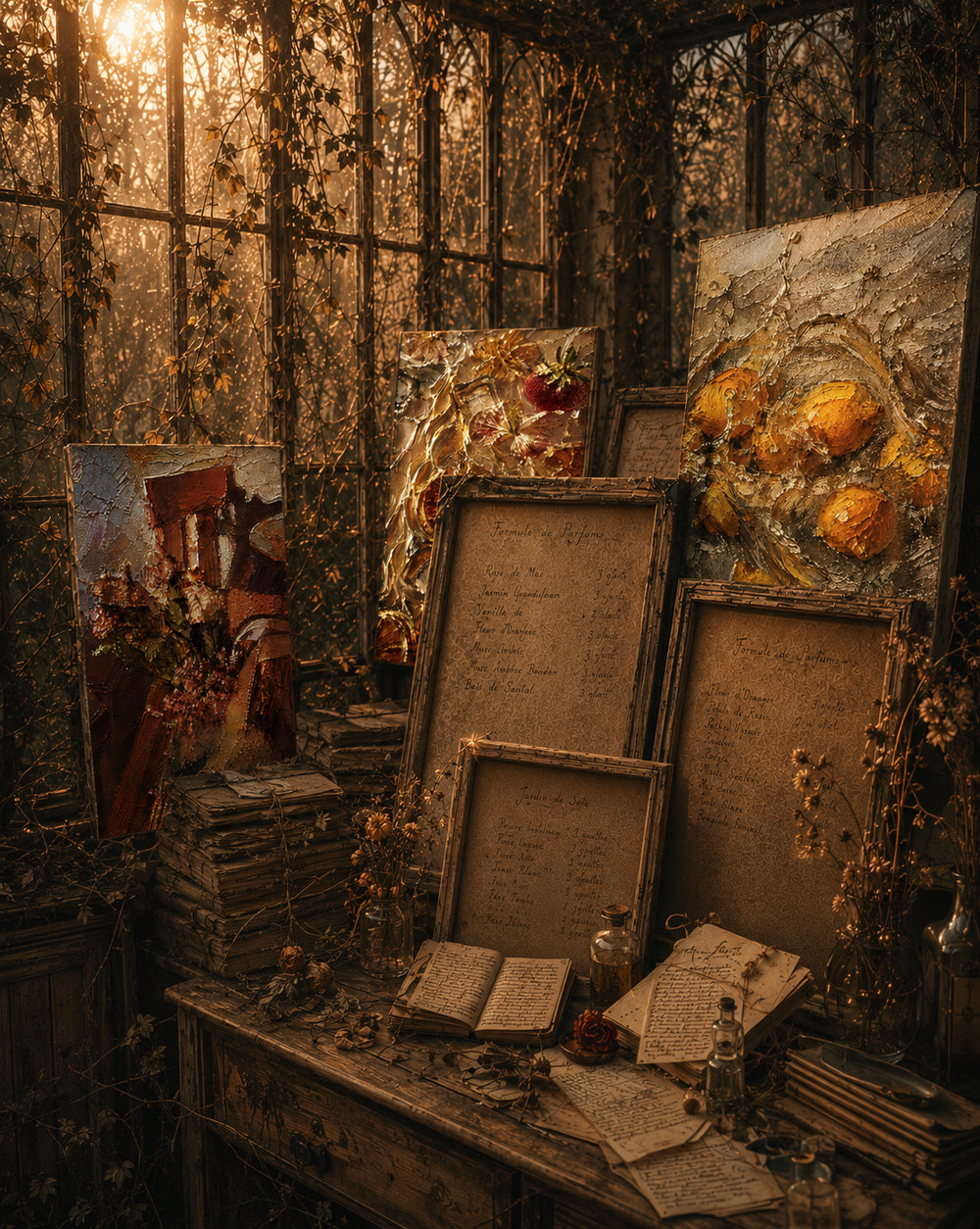
So she hid them where no one would think to look — behind the paintings she made. On the raw back of each canvas, in faded ink, she wrote the recipe for the memory the painting held. A garden in bloom on the front; the fragrance of that garden on the back.

She never explained herself. She never expected to be found. She simply kept making, and hiding, and remembering — trusting the future to be curious.

Chapter V — The Silence

The recipes that waited.

The years moved on, the way years do. The glass house cooled. Its panes clouded over, the garden grew wild at the edges, and her name settled gently into the quiet of the family's memory — spoken less and less, until it was hardly spoken at all.

But her recipes were not lost. They did not vanish; they waited. Folded into diaries, sleeping behind paintings, patient and unhurried — exactly like the fragrances themselves, the kind that reveal their beauty only to those who take the time to notice.

Chapter VI — The Rediscovery

Found by the ones who came after.

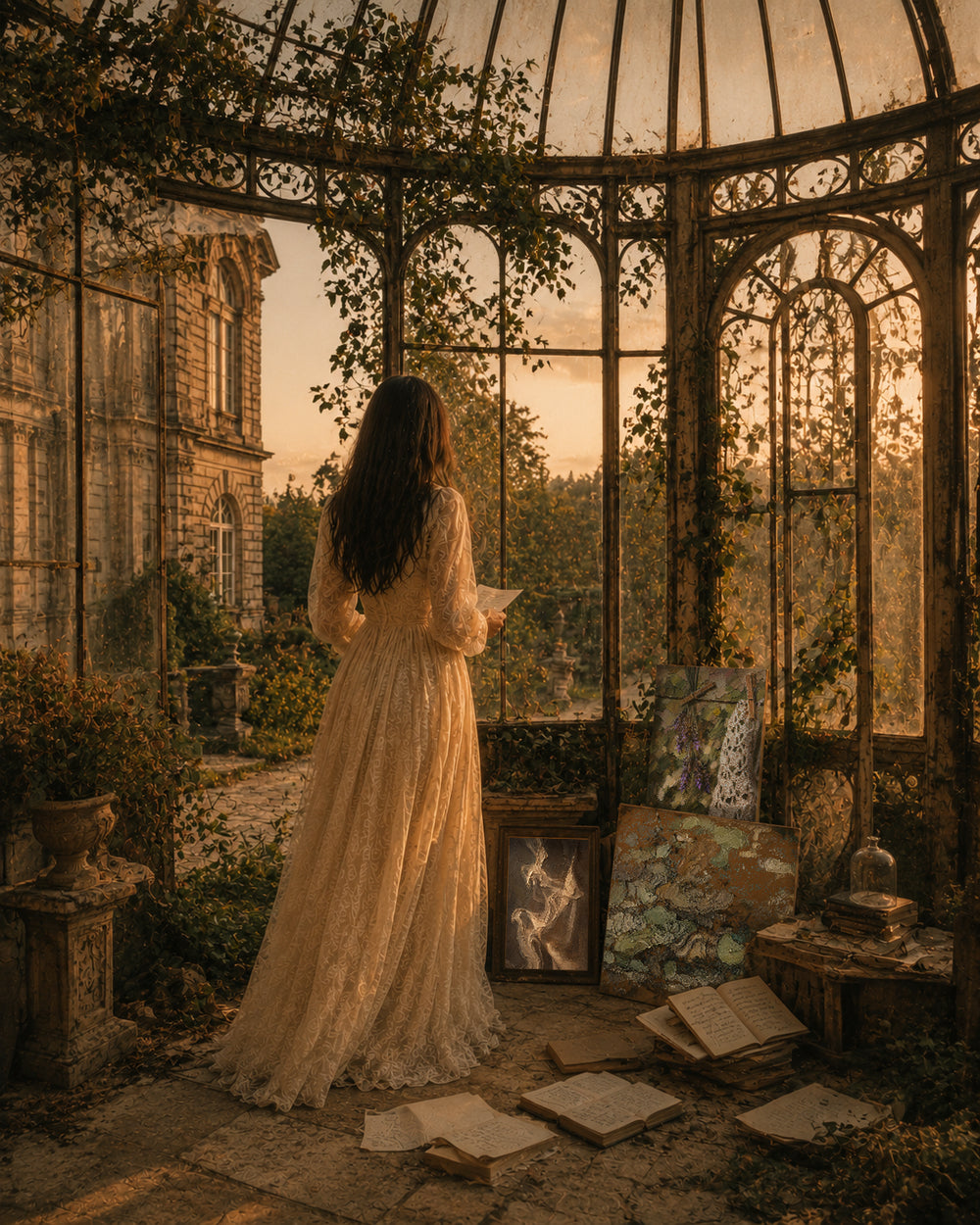
Generations later, her grandchildren returned to the old house to sort through what a long life leaves behind. Among the dust and the linen, they found her diaries — page after page of a beautiful, unreadable hand, and, between the lines, formulas.

And then, almost by accident, someone turned one of her paintings around. There, on the back, was more writing — a recipe, in the same faded ink. They turned another. And another. Behind nearly every canvas she had ever painted, a fragrance was waiting. An entire invisible library of scent, hidden in plain sight for a lifetime.

They read her notes the way you read letters from someone you have never met but somehow always known — and, one by one, her memories began to breathe again.

Chapter VII — The Revival

A house, and a name, brought back to life.

They did not want to copy the past. They wanted to let it breathe in the present — to give her forgotten fragrances a place in the homes and lives of today. So they revived her creations, one careful recipe at a time, and gave the house a name as soft as the velvet of memory itself: Velur.

Then they did the one thing she had never been able to do. They carried her glass house out into the world — all the way to the Emirates. Here, under a different sun, her scents found new air to fill: modern homes, quiet hotels, considered interiors.

Today, Velur is a bridge between past and present — inherited recipes, remembered feelings, turned into contemporary scent for the spaces where life is lived and remembered.

She spent a lifetime hiding her memories in scent. We spent ours setting them free.

She never made a scent from nothing. Every fragrance was a place she loved, a season she kept, a feeling she refused to let time erase — seven paintings, made in air.

Seven Memories

Seven Fragrances, Seven Stories

Each scent in the Velur collection began as a single memory, hidden behind a single painting. These are the stories she left for us to find.

01 — The Water Garden

Monet

Dew · Waterlily · Green Light

Before the house woke, she would slip down to the far edge of the garden, where an old pond lay flat and silver beneath the first light. Mist rose off the water in slow ribbons. The lilies, closed all night, began to open as the sun found them. She would sit at the water's edge and do nothing at all but breathe.

The fragrance she made from those mornings is green and cool and luminous — dew on a leaf, the still breath of water, a single white flower half-awake. There is no heat in it, only light.

She named it Monet, after the painter who spent his life trying to hold water and light on canvas. She did the same — only with air.

02 — The Southern Terrace

Matisse

Citrus · Warm Sun · Joy

This one she made at the height of summer, when the light was loud and the windows stood open from morning to night. She would set bowls of ripe citrus on the warm stone of the terrace and let the sun do half the work — the peel releasing its oils into the heat.

It is the most joyful of her fragrances: sun-warmed orange and lemon, a brightness that lifts the whole room. Where other scents remember quietly, this one remembers out loud.

She named it Matisse, for the painter of colour and southern light — because a scent, like a canvas, can be pure happiness if you are brave enough to make it so.

03 — The Flowers She Wore

Frida

Rose · Carnation · Warm Earth

There were days she felt most herself — days she wore flowers in her hair like a quiet act of defiance, and walked through the ordered house as if it were her own wild garden. This fragrance belongs to those days.

It is rich and warm and unafraid: velvet rose and spiced carnation over earth still warm from the rain, a bloom that refuses to apologise for taking up space. There is tenderness in it, but also strength.

She named it Frida, for the artist who wore her flowers like armour and turned her feeling into colour — passionate, honest, and entirely her own.

04 — The Traveler from the North

Ivan

Pine · Birch Smoke · Cold Air

One winter, a guest arrived from a far and frozen country. He came in from the cold with snow melting on his shoulders, pine and woodsmoke caught in the wool of his scarf, and stories of forests she would never see. He stayed only a season. But she kept the cold he carried with him.

The scent is dark and resinous and clean: pine needles, birch smoke, the sharp clarity of frozen air. It smells of distance — of somewhere far to the north, of a door opening onto snow.

She named it Ivan, after him — a memory of a person more than a place, and of the tender ache of missing somewhere you have never been.

05 — The Distant Land

Raza

Saffron · Amber · Incense

She built this one from letters and postcards — from descriptions of a warm, far country she dreamed of endlessly but never reached. Markets thick with spice, incense curling over sun-baked stone, saffron the colour of late afternoon. She travelled the whole road in her mind, and bottled what she imagined.

It is her most enveloping fragrance: golden saffron and warm amber wrapped in soft incense, a warmth that settles into a room and stays. There is longing in it — the sweetness of a place loved from a distance.

She named it Raza, and of all her scents it may be the one that travelled furthest — because years later, it would find its true home in the very part of the world she had only ever dreamed of.

06 — The Glass House Itself

Herba

Rosemary · Thyme · Green Stem

Some evenings, after a long day among the herb beds, she would lift her hands to her face and simply breathe them in. Rosemary and thyme, crushed leaf and cool green stem, the living breath of the glass house pressed into her own skin. Of all her fragrances, this is the most personal.

It is the greenest and most alive of the collection: aromatic herbs still wet with their own oils, a garden caught mid-breath, fresh and clean and quietly grounding. It does not remember a place so much as a feeling — of being exactly where you belong.

She named it Herba, plainly and truly, for the herbs that gave it life — and made it the heart of the home.

07 — The Timeless One

Morla

Moss · Aged Wood · Stillness

This was the last fragrance she ever made, in her older years, when she had grown quiet and the glass house had grown still. She made it from the oldest corner of the garden — moss on the low stone wall, aged wood gone soft with time, cool shade that never lifted.

It is her most peaceful scent, and her most enduring: earthy moss and worn wood, shadow and stone, a stillness you can almost hold. Where her other fragrances remember a moment, this one seems to remember all of them at once — and then let them rest.

She named it Morla, the timeless one, and left it as a kind of farewell — proof that some things, like memory and like scent, are not undone by time. They only wait.

All the way from France

Velur was born from forgotten recipes — revived through generations, carried across the sea, and released into the air of modern interiors, to shape how spaces are felt, and how they are remembered.